Holy crap. I just finished HL2:E1 a few seconds ago, and I'm going to say it was fantastic. I took tons of screenshots, and I'm going to play this again, of course, with the Valve commentary, but, for now, here's the review. I'm going to be incredibly critical because there's really no other way to do it.
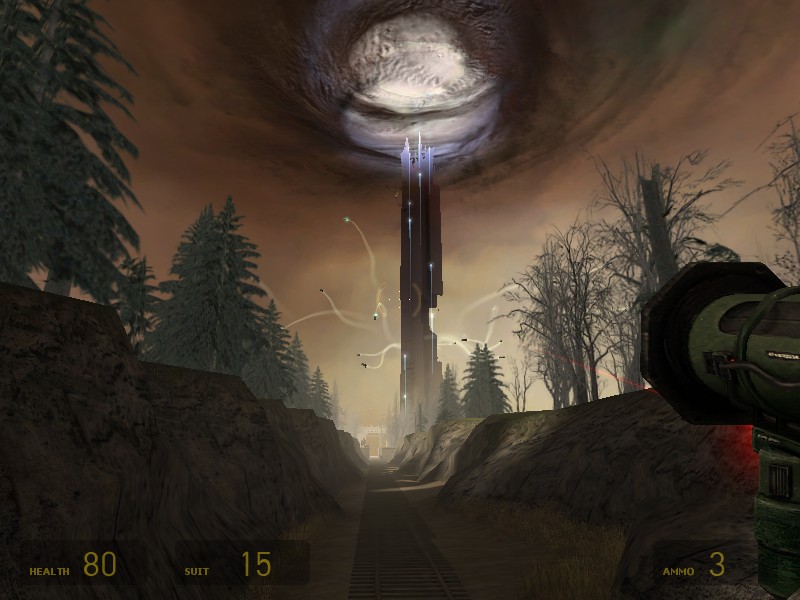
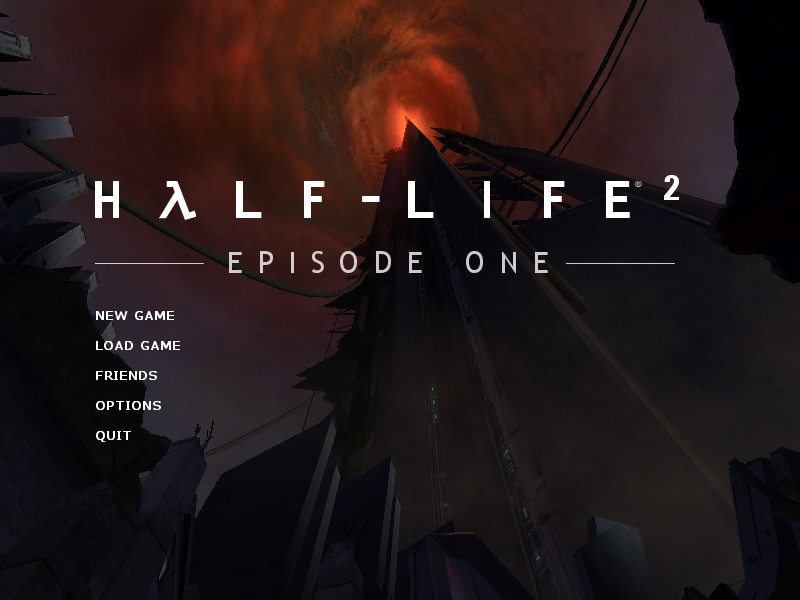
Opening screenshot

Valve has certainly reached the pinnacle (for now) of combining a video game experience with art. The attention to detail seen throughout the entire game is exquisite, and leaves me feeling I can play it again and discover more, without missing anything vital the first time. The experience is cinematic, in that not only is every screenshot appreciable as a single frame in terms of beauty and quality but also in terms of modelling and architecture, but the decor of the environments is amazing. The game took me 4 hours, all of which were today, and I'd say this is an excellent length for episodic content. It means one can stop and reflect at a suitable breakpoint. Compared to Sin:Episodes, which was released a few weeks ago, this was shorter and did not drag on. Comparing this installation to the original Half-Life 2, I noticed a few things: first, the colour tones throughout this game are darker, redder, more apocalyptic. Second, the near-constant presence of Alyx changed alot of things, especially the puzzles. Thirdly, unlike the original HL2, there was almost never a slow point. More on all these as we go on...
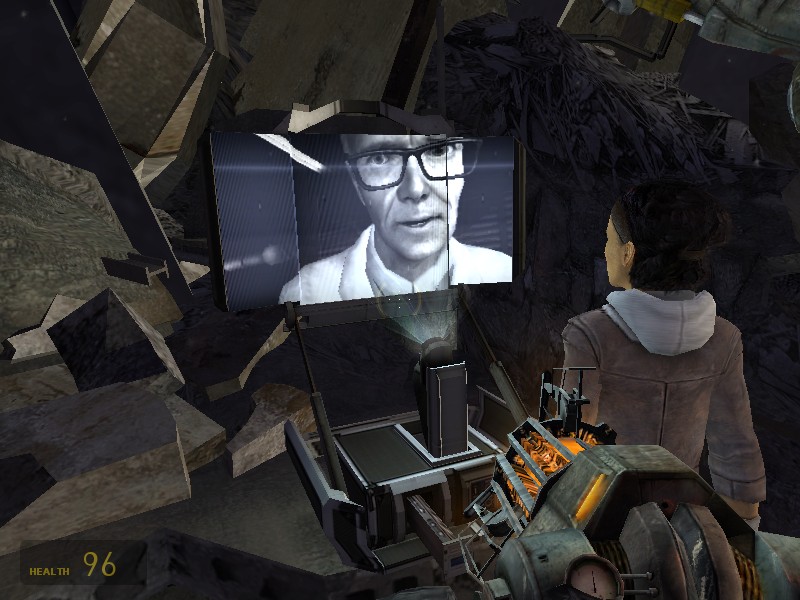
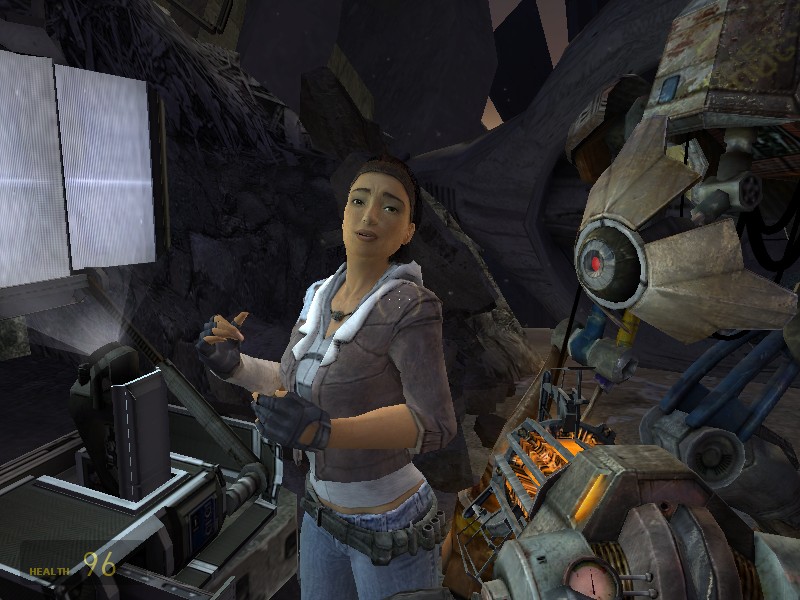
The game starts out with Vortigons overwhelming G-man as he comes to talk to you (Gordon) in the black void. This is an interesting break in the overwhelming omnipotence of G-man, and is quite a surprising turn. Gordon and Alyx appear somewhere on the ground level next to the Citadel, and receive some messages on a nearby terminal from Dr. Kleiner.

Dog also makes a reappearance. This is the first level of the game, Undue Alarm, and as with any Valve game, its easy technically, very expository, and very cinematic.

It's in this first section that I really noticed the darker tones. I bet if you took a spectral colour graph the shape would be unsimiliar to any seen in Half-Life 2, except maybe in Ravenholm (the best level of all time). On Dr. Kliener's advice, we're heading right back into the Citadel again to shut down the reactor core, which apparently is about to REALLY blow this time (the explosion at the end of HL2 was just a trigger).
Alot of the advertisments for this installation were showing off Alyx and Dog, and it looks like they meant business. I'm amazed at the attention to detail they've put into their expressiveness (although with Dog, its obviously easier). This really shows up more later in the combat sequences, which are so well choreographed its almost distracting. For now though, I applaud the animators, and whoever they were looking at when animating Alyx.
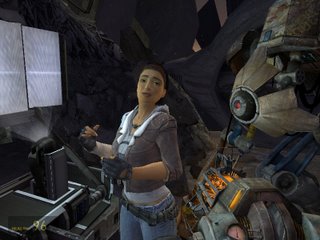
So Gordon and Alyx go down a little cliff area to get closer to the Citadel, and then, through some interesting and comic pantomime, Dog suggests they get in an old van, so that he can hurl them at a open area in the side of the Citadel across the expanse between the edge of the ground and its base.

This is well done cinematically, and suddenly turns into a roller-coaster ride when the Citadel's structure (which is breaking apart at this point) gives. After getting our bearings, we come across two creatures, who Alyx inexplicably call "Stalkers". You'd think she would explain this to Gordon, but based on clues given later, they appear to be Borg-esque humans who were taken in by the combine.
After a few more rooms, we come across a recorded message that we heard Dr. Breen leaving at the end of HL2. This is useful to remind us of the story, and I appreciate that it is there.

Its then that this odd creature appears, covered in some sort of white cocoon. These appear again at the end of the episode, without us determing what they are. Alyx doesn't even seem to know, in fact. Looks like Valve is happy to leave some loose ends for us to give us reason to keep the episodes coming (and what is wrong with that?). At some point here, the gravity gun (which was found near Gordon at the beginning of the game) is re-activated to its blue-energy levels, so I feel like we're right at the end of HL2 again. Through some analysis of Alyx's, its determined that we need to go re-establish the reactor's safety in order to give enough time for us to evacuate, as well as the Citizens of City 17. Thus begins Direct Intervention. So begins a puzzle sequence, at the onset of which Alyx says "Good thing you know what you're doing" in reference to Gordon Freeman's MIT training.

So, here's my beef with and Half-Life "puzzle". The puzzles are obvious, in that they interrupt the shooting gameplay and demand to be solved. There is nothing wrong with that, except that I find them painfully easy. Sometimes, in good Valve tradition, jokes are made about it, just like Alyx's comment above, but if you are going to interrupt gameplay, you had better do it for a good reason, or at least have a bit of a cerebral challenge. Alot of it feels like going through the motions, which is, frankly, bad design.

The particular "puzzle" on the left here is a good example. Aesthetically pleasingly, you are maneuvered like a dummy to find these three vertical generators empty of their generators balls (before screenshot). Look! - a generator ball tube nearby (these were actually pretty fun to navigate earlier). Lets fill these up! The way the game is designed, it won't let you leave the immediate area until you do something about these. Come on.
You return to Alyx to find that blowing up the Citadel was in some way related to transmitting an important information packet (worth blowing up the Citadel apparently), and the new goal is to get this information to Eli Vance and Dr. Kliener.

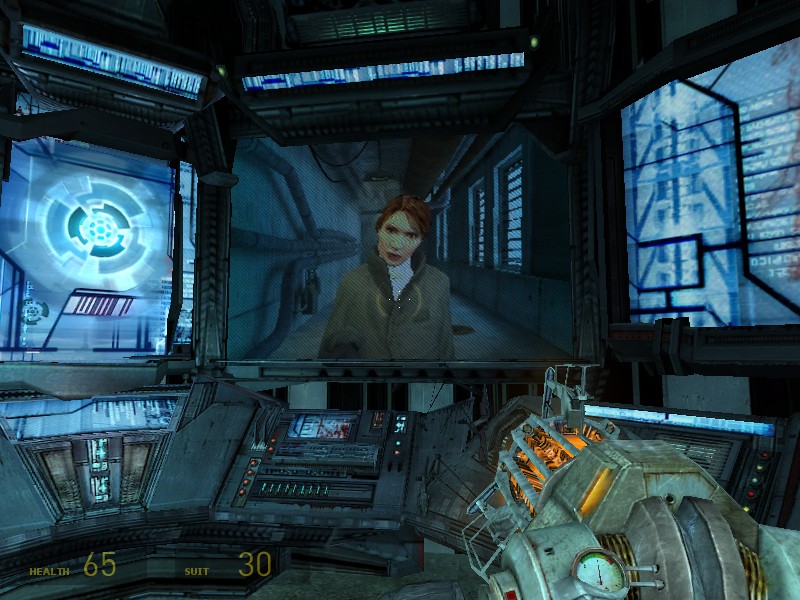
A second late, we see recorded message from Judith (from HL 2) to Dr. Breen about something that the combine weren't supposed to know about. This isn't dealt with in this episode, leaving yet another thing for later episodes. Awesome.

And, as we are leaving the Citadel on an elevator, the current chapter becomes Low Life. We board a train, the first of two train sequences in the game. This one, horribly enough, is full of more stalkers. The train breaks down deep underneath the city, and thus begins an incredibly dark portion of the game. Like, actually dark physically. It almost seems that the light has become a little thinner than in HL2. Its also cool that Alyx will only shoot at stuff that you light up. I noticed at this point that Gordon has still not recieved his traditional crowbar yet - it seems its been replaced as the do-all by the grav gun. Hmmm. Some humour starts to be injected to the game at this point. As we walk towards the first dark area, Alyx starts mimicing zombie noises, and then says "just kidding". This actually made me laugh out loud. Well done. She also makes fun of the short flashlight battery life, thankfully extended by some flares lying around. We meet a new enemy at this point, this combine zombie, or "zombine" as Alyx calls it. These run a little faster than the traditional zombie, and some of them will carry grenades around above their head, so that when they die and relese the mechanism, they explode shortly. This was an interesting gameplay element for Valve to add.
 We finally come across an elevator, and this is the really scary part. Its pitch black, there are zombies/zombines/running zombie-things (are these dogs with head crabs?) coming from three sides, and your battery has only some life. Also, some zombines will explode when killed. I died a ton of times here, until I found that holing myself and Alyx up in a corner fared better as I was able to predict which direction the attacks would come from.
Finally, the elevator comes and we break to the surface. It appears that Dr. Kliener has replaced Dr. Breen as the man-on-the-screen, touting all sorts of messages. This is awesome, especially because of his scientist awkwardness throughout his looped speech.
 Thus begins Urban Flight. This sort of combat is reminiscent of the latter end of HL2, and nothing much has changed (though there is little wrong with that!) We notice a change in the Citadel, and it appears that the reactor has been reversed, although we have bought some time to leave City 17.
Its at this point that I'm starting to notice a difference in the "puzzles" between this game and HL2. They feel dumbed down - in fact, the whole game does. I mean, I'm all for fun, but I feel cheated by easiness, or at least the lack of difficulty. As I said, if you're going to give me a puzzle, at least give me a hard one. In alot of cases, you learn by death in this game. Then, you go back and try again, dying each time until you get it right. A game should be designed so that, barring skill, you should be able to play it through once without dying. Alyx seems to be a device as well to blatently alert you about problems - "The crank for this door must be around here somewhere." Maybe this makes the game more accessible, or whatever, but you should really challenge your audience.
 In this particular "puzzle" where I had to navigate a room full of explosive, I simply threw a grenade down the ventilation shaft when I knew they were going to be there, thanks to the learn from dying technique. That shouldnt be possible. Fortunately, this sequence is over quickly enough, and we enter a "safehouse" with some other rebels. A TV is on, Dr. Kliener again replacing Dr. Breen in hilarious fashion. Dr. Kliener breaks the fourth wall repeatedly, by mentioning "exposition" just before he goes on a long rant about the state of City 17. He also alludes to the human population needing to expand itself, and there is some excellent tension thanks to Alyx.

As we're wandering through the safehouse, Gordon manages to voyeuristically spot a couple conversing, and although they dont grab much attention, they go on for quite awhile, including such wonderful snippit as
"sometimes I think everybody's a doctor but me"
"I kind of miss the combine"

Finally, we see Barney again, who gives us our missing crowbar. (Wow, I'm really mixing up the personal pronouns, eh?). There's some cool propoganda on the walls again. The next sequence is the most exciting sequence of the game, gameplay-wise, as we go through a hospital fighing zombies versus combine versus zombine, as the music heightens greatly. As a result, I didn't take many screenshorts, but lets just say it was pretty good. Finally, we arrive at the train station, just before the end of the level. Here, a pretty interesting gameplay style is introduced that I havent seen before you are tasked with rescuing a few citizens by accompanying them between two building across a dangerous area, and go back and forth several times. However each time the route and strategy is changed slightly as new enemies appear in different places, and due to wear and tear the route actually changes geographically. My issue was that there didn't appear to be any payoff for moving a certain number of citizens to the train, as some of them could die in the movement. For all I know, maybe you need to move a certain number before they "run out" at the delivery end, but I, as the gamer, can't tell that unless it was made obvious to me. There is some more anti-Dr. Breen propoganda here.

 Alyx says goodbye to Barney as he leaves on the train with the Citizens
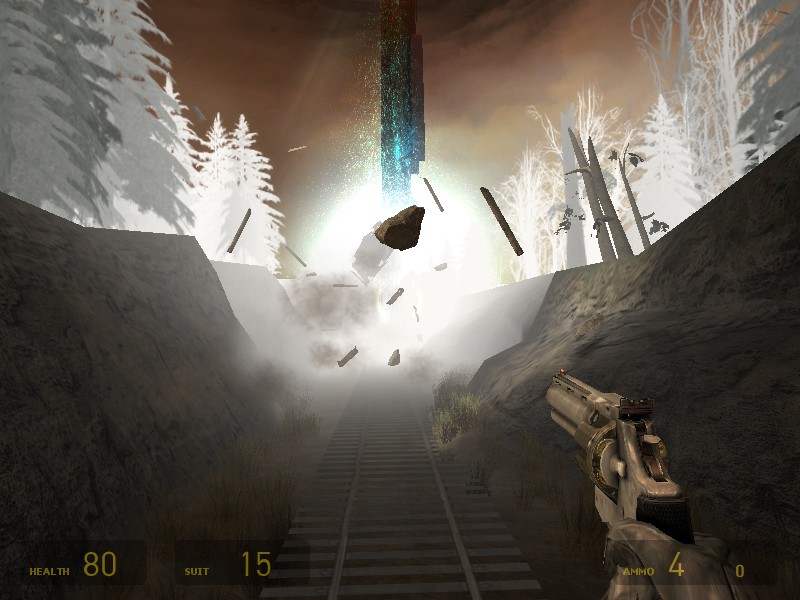
Finally, Alyx and Gordon board their own train (after some last-minute altercations) and we get to watch the Citadel as...a bunch of stuff happens that could only be descibed in pictures:


The game ends in a flash of white, after the Citadel explodes with Gordon and Alyx on the train. This was exactly the ideal length for an episode. While certainly feeling less EPIC that HL2 did, especially near the end with level names like "AntiCitizen One", it leaves alot for the remaining episodes in terms of plot and anticipation. New gameplay elements were added too, which is great for episodic gaming, as there is likely less time for playtesting to hone certain aspects of gameplay.
Verdict: Awesome. I look forward to more episodes.






 Alyx says goodbye to Barney as he leaves on the train with the Citizens