Monday, December 11, 2006

The Interactive Universe

I just discovered the most amazing game - Samorost. The control of this game is such that you play a character (in the loose sense) navigating about a world in a puzzle-solving mode. But, the cool part of this game is that you get to make choices about your environment which should be beyond your control.


In typical puzzle games, the player would only be able to make choices that the player's character could make, physically.

For example
You walk into a casino. You are presented with a choice to play either the slots or craps. Whether you win or lose is based on your skill and luck (if you actually play the game-wthin-a-game) or is pre-determined by the designer.

In the new style of the game (I'm not sure if it has a name yet) you get to make the choice about the outcome, like if you lose or win big at the slots. This sounds a little ridiculous at first. Doesn't it ruin the point of the game, which is to test your skill?

No.

Not when the game is about storytelling, and when the goal of the game being played is to produce the most interesting story, or a particular story the designer had in mind.

In Samorost, you can control parts of your environment which are beyond the normal control of your character, for example:

A bird's flight.
When a fish bites on a rod.
Which branch a monkey swings on.

The gameplay element is still there, as there is a set of correct choices to advance the story, but the choices that can be made are not confined to what is physically possible from the embodiment of the character's point of view.

OR

I had said that in Samorost you are playing a character in "the loose sense". The irregularities I pointed out about the character being able to do things beyond their control do not matter if you treat the game player as a "god" of the universe, with his/her own agenda. Then, what I had called the player's characters before is now just a character in the broader universe. I don't think this is necessary though.

I see a parallel between choices in this game sense and choices that I make as an improviser. When I play a story-based improv game, I play a role, and if I'm playing improvisation properly, I make good choices that drive the story forward and make it interesting. This is done by feeding, endowing, offers etc.

For example

Someone passes me a (mimed) envelope. I say something like
"I see, its the inheritance from my grandmother."
Or
"Oh no! A death threat!"
Or
"Strange...just an address and a time."

All of which would advance the story. I wouldn't make a choice like:
"Its the utilities bill."
Or
"Another Christmas card from the Jefferson's."
Or
"Its the wrong address."

NOTE: The wrong choices here could potentially lead to stories, but they aren't as immediately interesting as the first three.

The choices that I as an improvisor should make are any that advance the story. Not a choice that my character made, but one that I as an improvisor made about the universe. So, I don't think its necessary to view the gameplayer as a "god" of this particular game, Samorost. It takes some emotional attachment away from the player's character, which I might add is really cute. The objectives of the character (stop an object from hitting his home in Samorost I, rescue his dog in Samorost II) are less personal if the gameplayer is treated as a god, and not an extension of the character. This lowers stakes (BAD IMPROV!)

Coming up, I'm trying to introduce these sort of choices in my choose your own adventure, "A night on the town". I'm writing it in flash now, and once the story structure is down I'm going to go through again and make the language prettier. Keep watching!

Monday, December 04, 2006

Why is the Pioneer Plaque so sexist?

My home page for the last while when Firefox starts has been the wikipedia start page. Just a few minutes ago, I was greeted with this:


This is the Pioneer Plaque, a gold-engraved image sent out on the spacecrafts Pioneer 10 and Pioneer 11. For those that didn't know, these were two spacecrafts that were launched in the mid-70s to take advantage of the gravitational slingshot effect of the solar system's planetary alignment in that decade. The Voyager spacecrafts were launched later for the same reason.

Presumably, some intelligent race of creatures will find this plaque and be able to decipher all sorts of things about the human race, including the location of Earth (oh no! cylons!) (Un)fortunately, it will take the age of the galaxy already at least for the spacecraft to get anywhere near a habitable solar system, so chances of the plaques actually being seen are slim.

ANYWAY

What I'm getting to is that the engraving is horribly sexist. The male stands strong, waving one hand at whoever gazes on the engraving, while the women slumps to one side, doing nothing other than being present, and not really even having a facial expression. Come on! This was the seventies!

PS. "AI for Game Developers" just came in the mail today. Oh man!

Tuesday, November 28, 2006

Is there a pedagogical value to being confusing?

When a teacher makes a lot of mistakes, and you notice them and shoot up your hand to correct them, are you learning more or less than if the teacher was right all the time?

What if it isn't you shooting up your hand, but someone in the same class as you?

Since my degree is practical and science-oriented, most of what I learn is self-consistent rule systems (math, thermodynamics, physics). So, it is pretty easy to notice when a mistake occurs during teaching, and they are quickly rectified.

My opinion is that small mistakes make the transmission of information more clear, as it encourages you to correct information. So, should a teacher do it on purpose?

I am a T.A. for first-year calculus, and mostly I teach how to work through problems. When I am designing how to teach a problem, I build in common mistakes that people make and, of course, a few of my own by accident. Then, the process of doing a problem is much more interactive, and I think it makes for better students.

Comments?

Saturday, November 25, 2006

Flash is back

I used a new FTP site, so here is my first flash again.


Watch for more coming up!

Saturday, November 18, 2006

Ruben's Tube

Whenever I see something like this, it gives me more reason to become an eccentric rich person who retires to live in a museum owning all sorts of shit like this.

Wednesday, November 15, 2006

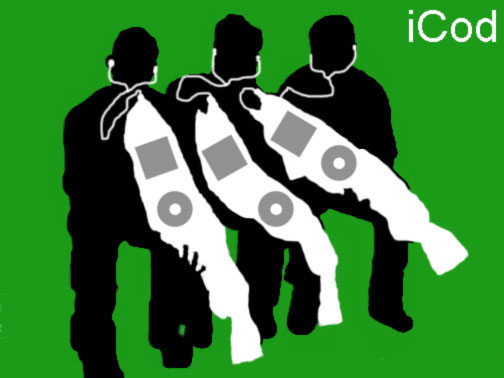
The new iCod


And the original:

Theory of Forms what? what?

I love the ancient idea of Theory of Forms by Plato. I try to reference it as much as possible in conversation.

The idea that there are two worlds, the real one, and than a higher one of perfect ideas is a very old-fashioned belief. The Theory is summed up as this:

The Theory of Forms typically refers to Plato's belief that the material world as it seems to us is not the real world, but only a shadow of the real world. All relation as form becomes the basis for discovery of the form, an inference of the ancient Greek schools.
-From the Wikipedia article

Case in point: Plato actually opposed to the creation of "art" because it was imitating something in our reality, which was already a bastardized version of what existed as a "being" form. As if where an object stood in the hierarchy or reality determined its worth.

Anyway, I find anything that perverts this presumed hierarchy of the world refreshing, like this hotel room with all the edges outlined to make it look like a cartoon:

Link.

Tuesday, November 14, 2006

What have I been up to?

With my (barely) free time?

Playing Hitman 2 - it's a beautiful combination of TPS, puzzle solving, and cinematic experience. It's the sort of game I would be proud making.

Tuesday, November 07, 2006

The Statistics of Awesomeness

I have a very deep faith. Faith, that in the large but not infinite set of possible events on this planet, awesome things happen.

There are, after all, six billion conscious beings on earth. That is a really big number. Now that may not be a good objective indicator of all the different things that happen, but STILL. Big number.

The whole point of this is that somewhere, at some point, I have a deep belief that a Banana Truck hit a Toy Marble Truck during a Roller Blade Derby.

The only unfortunate part is that no-one has sent me the pictures yet.

Wednesday, November 01, 2006

The Definition of an Artist

This following is not bullshit.

As far as I can tell, people who call themselves artists do little to create things that are "new". (There is nothing wrong with that, by the way)

I am of the belief that all that will or can be created exists in people's minds already in lesser forms.

An artist solely exists to notice things that are cool or important or relevant and to say "Hey, look at this people." Whether these are things that already exist (found art), or things they have amalgamated themselves, but already did exist in mental space, they are just noticing the cool things.

People who are good at this, according to measures of popularity, become better artists. And what they tell people to look at ("Hey, hey! Right here! Look at me!") is believed to be more artful or important than others, as is probably so.

There are no entrance requirements to be this sort of person. Just as there are no special privileges alloted once you are this sort of person.

Okay, I'm off to do some Advanced Math.